Middle school decisions in a city as large as Los Angeles come with a lot of options and not much guidance on how to actually compare them. Families searching for a private middle school in Los Angeles are usually weighing academic rigor, social-emotional support, and high school placement all at once, often without a clear framework for any of it.
Look for a program where kids rotate among teachers who each focus on one subject, math, English, science, history, rather than staying with one generalist all day. That structure gives real depth in each subject and also mirrors what high school will look like, so middle schoolers get practice managing different teachers and expectations before it counts toward a transcript. It also gives kids a wider range of adults on campus who genuinely know them.
A strong middle school curriculum should hand students more independence every year: longer projects, less hand-holding, higher expectations for staying organized. Ask how a school actually teaches planning and time management, not just assumes seventh graders will figure it out. That skill matters as much as the content itself heading into high school, where the workload jumps and the support often doesn't.
A school with a few hundred students total can still run large classes if enrollment is uneven across grades. Ask for the actual numbers at the middle school level specifically: students per class, sections per grade, and how the school handles a grade that grows too large for one classroom. It's also worth asking whether ratios hold steady across sixth, seventh, and eighth grade, or loosen as kids get older.
In a city with competitive high school admissions, middle school is where that groundwork gets built. Ask directly whether there's a dedicated point person for high school applications, whether teachers write recommendation letters, and what guidance exists around standardized testing if the high schools you're considering require it. A school that treats this as part of its job, not something families sort out alone, takes real pressure off an already stressful eighth grade year.
Middle school is a turning point socially as much as academically. Ask whether teachers are trained to notice confidence dips and social friction at this age, and whether there's structured time, advisory periods, one-on-one check-ins, built in to address it directly, rather than leaving kids to sort it out on their own. A middle schooler who feels backed outside the classroom tends to take more risks inside it.
Some Los Angeles families are choosing a brand-new school for middle school; others are looking at a school their child has already attended since elementary. Ask what that transition actually looks like for new sixth graders, and how a school helps them catch up socially with kids who've been there for years. A strong program has a real answer here, not just an assurance that "kids adjust fine."
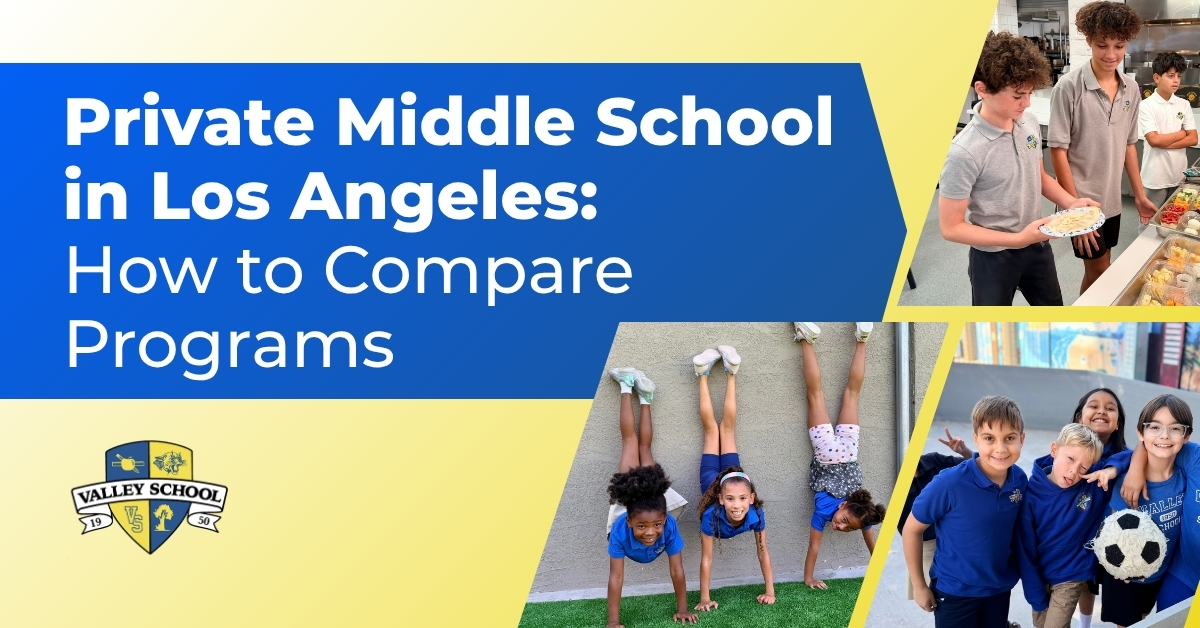
Valley School's middle school runs on the same PK-8 campus in Van Nuys as every grade before it, so most students already know their teachers, classmates, and campus well before sixth grade even starts. If you're comparing private middle schools across Los Angeles, come tour ours and see that continuity firsthand.