
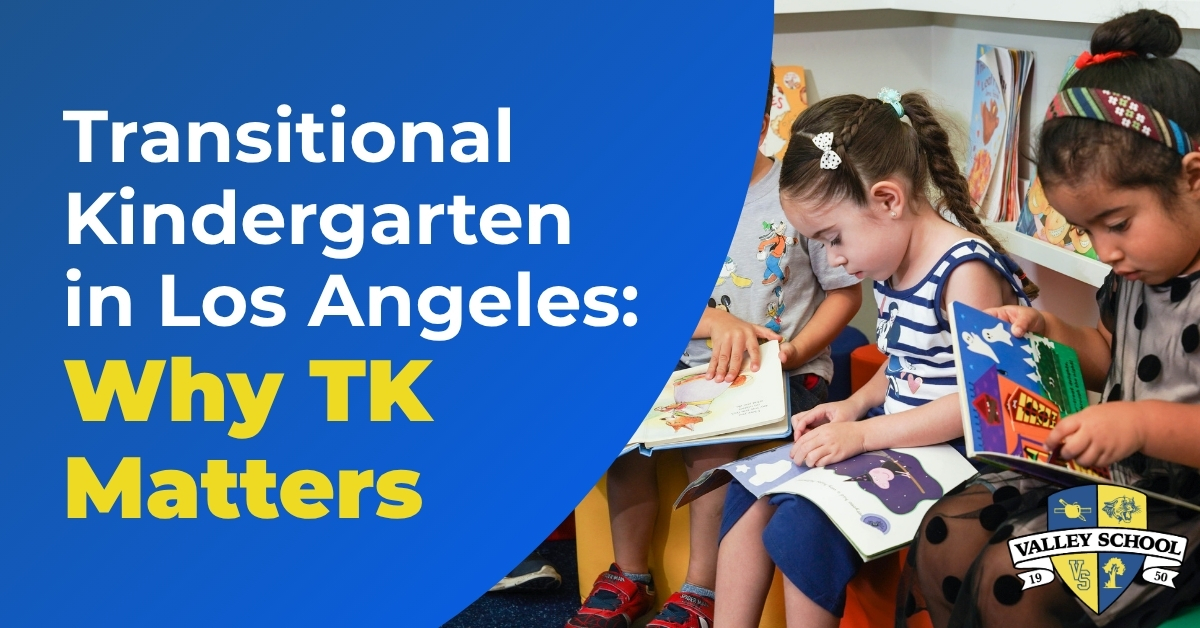
Transitional kindergarten, TK for short, might be the least understood stage of early education, and one of the most useful. If you're researching transitional kindergarten in Los Angeles, the real question isn't whether a school offers it. It's whether the program was actually built for the kids sitting in it.
A full year can separate the oldest and youngest kids in a kindergarten class, and that gap is bigger than it sounds at this age. TK exists to give younger kids extra time to build the stamina, fine motor skills, and self-regulation that kindergarten just assumes they already have. Done well, TK blends real literacy and math instruction with the play-based learning kids already know from preschool, so the jump feels more like a step than a leap.
Picture whole-group lessons, small-group work, and independent choice time, all in the same morning. Letter sounds and number sense get practiced in short bursts, then kids move into centers, building, art, dramatic play, that circle back to the same concepts through hands-on exploration. Good teachers are watching for readiness signs the whole time and keeping families in the loop on how their child is progressing.
Whether a child belongs in TK or kindergarten is rarely obvious, and it shouldn't come down to a birthdate on a form. Ask how a school's admissions and teaching staff actually make that call, and whether they do it family by family. It matters, too, whether TK is part of the same program as the rest of the school. A kid who starts in TK should already feel like part of the place, not like a new student showing up cold a year later.
Is TK the same as kindergarten? Not quite. Will my child repeat material in kindergarten? A well-sequenced program shouldn't repeat, it should build on what came before. Does TK count toward continuity with elementary enrollment down the line? At a school that runs preschool through eighth grade, it usually does, since your child is already part of the same system. These are worth asking directly rather than assuming, because programs genuinely differ on all three.
Some families consider simply holding a child back a year and starting kindergarten late instead of enrolling in TK. It's worth understanding why that's usually the weaker option. TK classrooms are built by teachers who specialize in this exact age and stage, with a curriculum designed around it from the ground up. A child kept out of school entirely for a year loses that structured, peer-based environment, and how much they gain instead really depends on what fills that year in its place. If the real choice in front of you is a purpose-built TK classroom versus an extra year at home, the classroom usually wins, mainly because it's built for exactly the developmental moment your child is in right now, not just for extra time passing.
Because TK sits between two very different developmental stages, communication matters more here than almost anywhere else in early education. Ask how often teachers send updates, whether conferences happen once a year or several times, and what a progress report actually measures at this age, since traditional grades don't really apply yet. Look for specific language: can my child sit through a fifteen-minute lesson, can they write their name, are they starting to sound out simple words, rather than a vague comment like "doing great." Specific feedback early on makes the eventual kindergarten transition a lot less of a guessing game.
At Valley School, TK isn't a separate track, it's built into the same PK-8 program as everything else, and our admissions team works through placement one family at a time. If you're weighing TK options in Los Angeles, reach out and we can talk through where your child actually is, not just their age on paper.
Find out more about our Early Childhood Center.
.png)